El silencio está ocupado (Silence Is Occupied) · Three in the Studio
A correction that made the work worse
The edit of El silencio está ocupado (Silence Is Occupied) was well advanced. At one point, the dark green field gave way to a brighter image of burgundy and ochre. The cut was visible, although there was no black frame or export error.
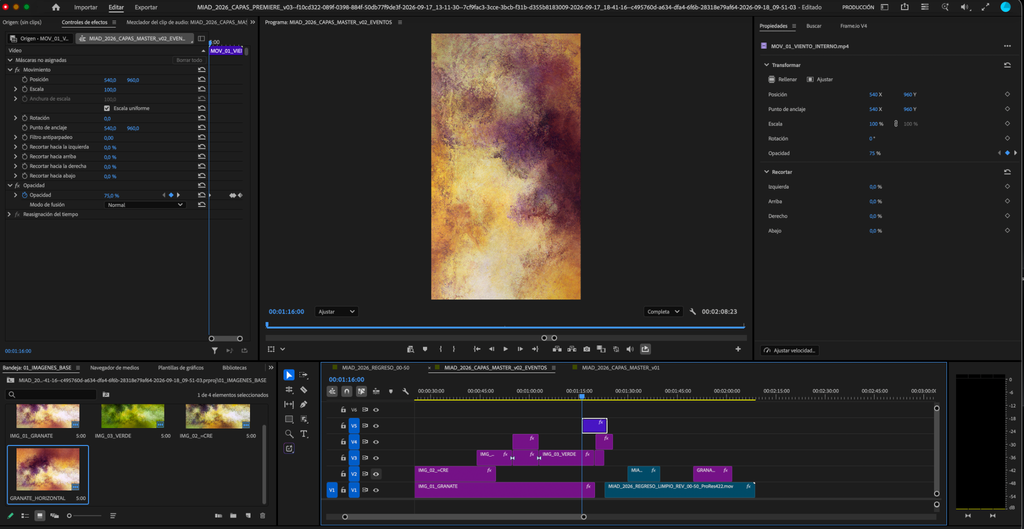
The AI suggested extending a green layer to soften it. The idea was reasonable: it respected the palette and followed the logic of superimposition we had used to build the piece. I decided to try it.
The colours flowed together more smoothly, but the work lost its strength. The spatial planes did not align; the cut was still there, only weakened. Extending the green also blurred the distinction between the end of one area of the work and the beginning of another. I removed the trial layer and restored the previous edit.
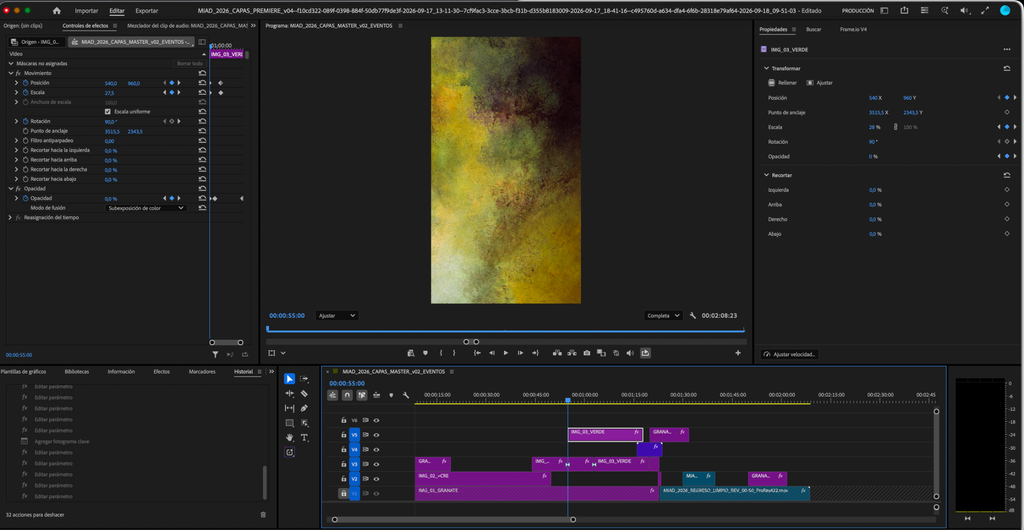
What I had seen
The AI’s suggestion addressed a local problem: making a transition less abrupt. My objection concerned the work as a whole. That break marked a change of territory and prepared the return. Softening it made the journey more uniform and harder to read.
I could not put all of this into words before trying it. First I sensed that the work had become worse; only afterwards could I explain that the continuity of colour was erasing a necessary spatial and narrative distinction. In an abstract painting, this sense of orientation does not depend on depicting a place. It can emerge from the relationships between areas, movements, entrances and returns.
The test was useful precisely because it could be undone. The AI helped turn a doubt into a concrete operation; when I saw it in place, I decided that the operation did not belong in the work. We also kept a record of why it was rejected, so that the same correction would not reappear as unfinished business when we returned to the project.
Choosing also means removing
In this episode, the most important decision was not to add something. It was to recognise that a technically defensible solution weakened the work, and to go back.
That distinction matters to me when I work with AI. It can make suggestions, compare options and help me carry out tests. The work, however, calls for a judgement that takes shape as I look at it and work on it. Sometimes that judgement first appears as a refusal and only later finds words.
This episode is part of a practice that continues to change. What I keep is the test, the decision to remove it, and a question that may return with another work: when does a transition need to be softened, and when does it need to remain a cut?